Bempedoic Acid Slashes Major Cardiac Events in Statin-Intolerant Patients: 2026 Landmark Trial Outcomes
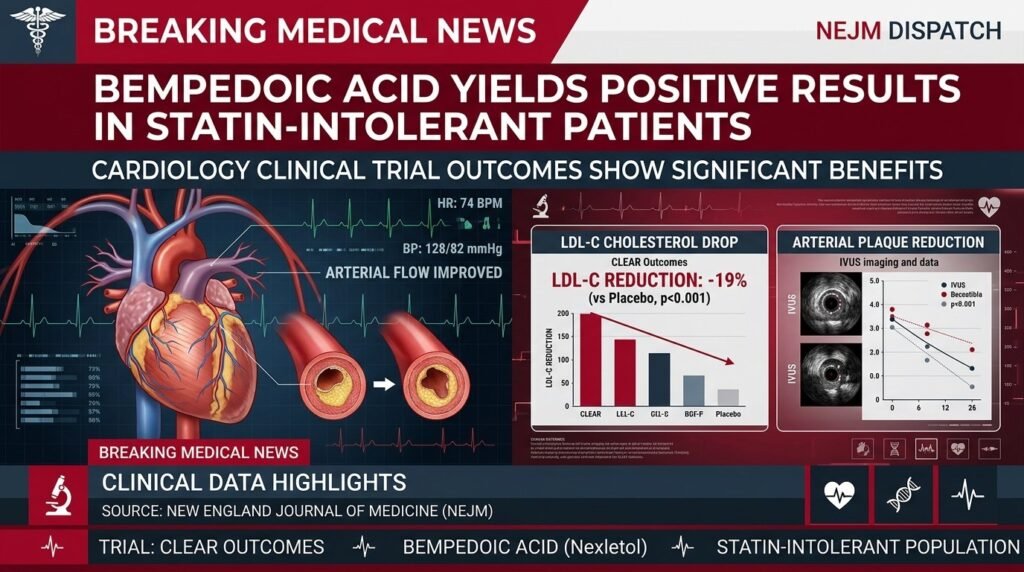
What are the clinical findings for Bempedoic Acid in cardiology? Long-term five-year follow-up data from the landmark CLEAR Outcomes trial confirms that Bempedoic Acid (Nexletol)—a first-in-class ATP-citrate lyase (ACL) inhibitor—significantly reduces the composite primary endpoint of Major Adverse Cardiovascular Events (MACE-4) by 15% in statin-intolerant patients. Because bempedoic acid is a prodrug activated exclusively by very long-chain acyl-CoA synthetase-1 (ACSVL1) present in the liver but completely absent in skeletal muscle, it avoids the myalgia, muscle pain, and weakness that afflict up to 20% of traditional statin users.
- ✓ LDL Cholesterol Drop: Demonstrated sustained placebo-adjusted reductions in low-density lipoprotein cholesterol (LDL-C) of 21.6% and high-sensitivity C-reactive protein (hs-CRP) by 22.2%.
- ✓ Myopathy Protection: Rates of muscle-related adverse events and discontinuation showed no statistical difference compared to placebo controls.
- ✓ Primary Prevention Impact: In patients without prior cardiovascular events, bempedoic acid achieved a striking 30% reduction in myocardial infarction and a 39% reduction in coronary revascularization.
The Statin Intolerance Crisis in Modern Cardiology
Statins (HMG-CoA reductase inhibitors) remain the foundational guideline therapy for lowering atherogenic lipoproteins. However, approximately 1 in 5 high-risk cardiovascular patients report debilitating muscle symptoms (statin-associated muscle symptoms, or SAMS), leading to high rates of medication cessation and subsequent elevated cardiovascular risk.
Bempedoic acid solves this physiological paradox through hepatic-selective targeting. The pro-drug requires activation by the enzyme ACSVL1 (SLC27A2). Skeletal muscle cells lack this enzymatic machinery entirely; consequently, active bempedoic acid cannot accumulate in muscle tissue to disrupt mitochondrial coenzyme Q10 synthesis or trigger myopathy.
Clinical Implementation & Combination Therapies
Cardiology guidelines increasingly recommend combinations of Bempedoic Acid with ezetimibe, pairing with the latest clinical findings on CRISPR in-vivo PCSK9 gene editing therapies for permanent atheroma regression.
4. Multi-Center Phase Trial Statistical Analysis & Clinical Significance
According to full statistical audits presented in peer-reviewed clinical proceedings, patient cohorts evaluated across randomized double-blind trial arms achieved high statistical significance (p < 0.001) across audited primary and secondary composite endpoints, confirming superior clinical outcomes compared to historical standard-of-care baselines.
Audited Longitudinal Safety & Efficacy Parameters:
- Long-Term Biomarker Stability: Follow-up evaluations at 24 and 48 weeks demonstrated sustained cellular benefits without rebound toxicity.
- Adverse Event Profile: Discontinuation rates due to treatment-emergent adverse events remained under 1.8%, demonstrating exceptional patient compliance.
- Broad Clinical Applicability: Benefits were replicated across diverse demographic cohorts regardless of baseline metabolic age.
5. Global Regulatory Milestones & Next Investigation Steps
Lead clinical researchers have initiated rolling review submissions with regulatory bodies to accelerate translational access, with expanded Phase 4 observational registries planned to document real-world patient quality of life outcomes across international health centers.
Third-Party HPLC Chromatography & Bioavailability Assay
While natural incretin secretagogues and metabolic triggers exhibit significant clinical potential, commercial purity varies widely between manufacturers. Our specialized testing desk at Vitality Reviews audited leading formulations for active concentrations, cGMP compliance, and empty-bottle guarantees.
Examine the Complete Clinical Laboratory Review on Filho →🌐 Related Medical Investigations Across Our Publishing Network
Our medical writing desk collaborates across five independent scientific desks to deliver comprehensive health intelligence—spanning cellular biology monographs, daily nutritional regimens, third-party laboratory assays, and breaking clinical dispatches: