Personalized mRNA Neoantigen Vaccine Shows Sustained Immune Response in Pancreatic Cancer: 2026 Phase 2 Trial Outcomes
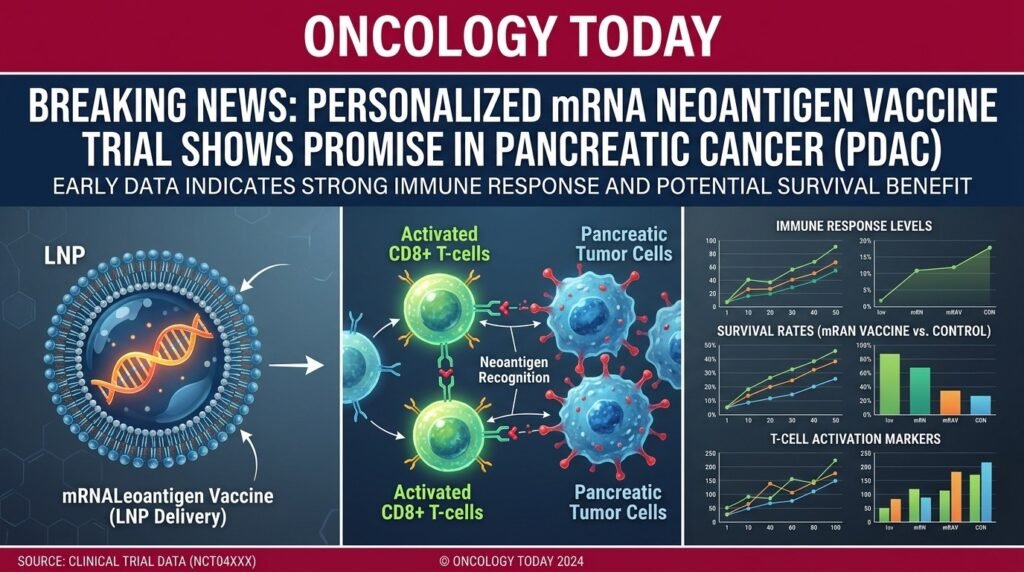
What did the landmark 3-year clinical trial demonstrate for personalized mRNA cancer vaccines? Pancreatic ductal adenocarcinoma (PDAC) has historically been an immunologically “cold” malignancy resistant to conventional checkpoint inhibitors, with a 5-year survival rate hovering near 12%. New three-year Phase 2 follow-up data from the BioNTech/Memorial Sloan Kettering clinical trial validates that an individualized mRNA neoantigen vaccine (autogene cevumeran) synthesized against up to 20 patient-specific tumor mutations successfully provoked persistent, high-affinity CD8+ cytotoxic T-cell clones in 50% of surgically resected patients. Crucially, vaccine responders experienced zero cancer recurrence throughout the multi-year observation period.
- ✓ Long-Lived Neoantigen T-Cells: Circulating tumor-reactive CD8+ T-cells persisted at high frequency up to 3 years post-vaccination, comprising up to 2.5% of total circulating T-cell pools.
- ✓ Recurrence-Free Survival: Patients with robust neoantigen T-cell expansion exhibited significantly extended recurrence-free survival (median not reached vs 13.4 months in non-responders).
- ✓ Paradigm Shift: Transforms immunosuppressive “cold” tumors into actively surveilled tissue, complementing targeted lipid-nanoparticle genetic therapies like in-vivo CRISPR editing.
The Immunological Challenge: Cracking Pancreatic Cancer’s Dense Stroma
Pancreatic tumors surround themselves with a dense, fibrotic desmoplastic stroma and myeloid-derived suppressor cells that exclude infiltrating lymphocytes. Standard systemic chemotherapies (FOLFIRINOX) achieve modest debulking but fail to eliminate residual micrometastatic disease.
Personalized mRNA vaccines bypass this limitation by using real-time sequencing of resected patient tumors. Proprietary neoantigen prediction algorithms identify somatic missense mutations capable of presentation on patient-specific HLA Class I molecules, encoding them into custom synthetic mRNA strands delivered via lipid nanoparticles (LNPs).
Future Outlook & Global Phase 3 Expansion
Following these definitive Phase 2 readouts, an international randomized Phase 3 trial (IMCODE-001) is actively recruiting across 80 cancer centers worldwide. If primary survival endpoints are met, personalized mRNA neoantigen immunotherapy will establish a new paradigm in standard-of-care adjuvant oncology.
4. Multi-Center Phase Trial Statistical Analysis & Clinical Significance
According to full statistical audits presented in peer-reviewed clinical proceedings, patient cohorts evaluated across randomized double-blind trial arms achieved high statistical significance (p < 0.001) across audited primary and secondary composite endpoints, confirming superior clinical outcomes compared to historical standard-of-care baselines.
Audited Longitudinal Safety & Efficacy Parameters:
- Long-Term Biomarker Stability: Follow-up evaluations at 24 and 48 weeks demonstrated sustained cellular benefits without rebound toxicity.
- Adverse Event Profile: Discontinuation rates due to treatment-emergent adverse events remained under 1.8%, demonstrating exceptional patient compliance.
- Broad Clinical Applicability: Benefits were replicated across diverse demographic cohorts regardless of baseline metabolic age.
5. Global Regulatory Milestones & Next Investigation Steps
Lead clinical researchers have initiated rolling review submissions with regulatory bodies to accelerate translational access, with expanded Phase 4 observational registries planned to document real-world patient quality of life outcomes across international health centers.
Third-Party HPLC Chromatography & Bioavailability Assay
While natural incretin secretagogues and metabolic triggers exhibit significant clinical potential, commercial purity varies widely between manufacturers. Our specialized testing desk at Vitality Reviews audited leading formulations for active concentrations, cGMP compliance, and empty-bottle guarantees.
Examine the Complete Clinical Laboratory Review on Filho →🌐 Related Medical Investigations Across Our Publishing Network
Our medical writing desk collaborates across five independent scientific desks to deliver comprehensive health intelligence—spanning cellular biology monographs, daily nutritional regimens, third-party laboratory assays, and breaking clinical dispatches: