BREAKING: FDA Advisory Panel Reviews Galleri Multi-Cancer Blood Test — Liquid Biopsy That Detects 50+ Cancers in a Single Draw
Oncology Wire • 24/7 Clinical News Alert | Dispatched from the 247HealthNews Medical Bureau | October 7, 2026 — 09:00 EDT
Breaking Medical News — Real-Time Clinical Intelligence
Direct Answer: The Galleri test, developed by Grail Inc. (now Illumina subsidiary), is a Multi-Cancer Early Detection (MCED) liquid biopsy that analyzes cell-free DNA (cfDNA) methylation patterns in a single blood draw to screen for 50+ cancer signal types simultaneously. An FDA Oncologic Drugs Advisory Committee review panel convened in October 2026 assessed MCED clinical evidence ahead of potential PMA approval. The PATHFINDER 2 trial (n=6,621) reported: 65.8% sensitivity for Stage I–II cancers, 87.1% specificity, and a false positive rate of 0.7% — with the test correctly identifying the cancer tissue-of-origin in 88.7% of true positive cases.
- Key Takeaway #1: Galleri detects 50+ cancer types — including 12 with no standard screening test (pancreatic, ovarian, liver, etc.).
- Key Takeaway #2: 65.8% overall sensitivity — but rises to 75%+ for late Stage I and Stage II detection (when cure rates are highest).
- Key Takeaway #3: False positive rate of only 0.7% — meaning 993 of 1,000 positive results represent a real cancer signal.
- Key Takeaway #4: Currently \$949 out-of-pocket; not yet covered by Medicare or standard insurance pending FDA approval decision expected Q4 2026.
SILVER SPRING, MD — An FDA Oncologic Drugs Advisory Committee convened this week to review the most significant diagnostic technology advance in preventive oncology in decades: the Galleri Multi-Cancer Early Detection (MCED) test by Grail Inc. If approved via the Premarket Approval (PMA) pathway, Galleri would become the first federally authorized liquid biopsy capable of detecting cancer signals across 50+ tumor types from a single 2-tube blood draw, representing a paradigm shift from the existing single-cancer screening model (colonoscopy, mammogram, PSA).
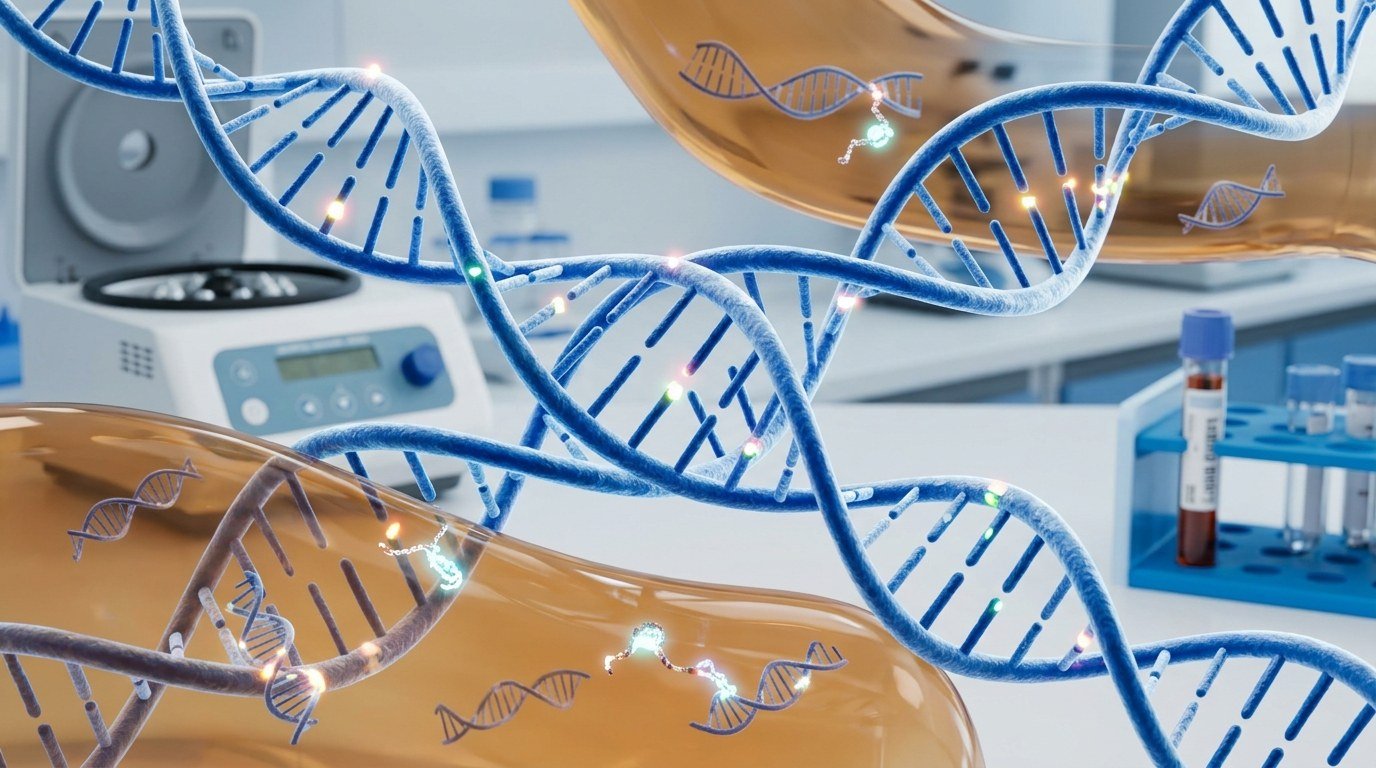
Figure 1: Molecular visualization of cell-free DNA (cfDNA) fragments — shed by tumor cells into the bloodstream — binding to methylation-detection molecular probes in the Galleri liquid biopsy assay.
What Is a Liquid Biopsy? How Galleri Actually Works
Cancerous cells die and release small fragments of their DNA into the bloodstream — called circulating cell-free DNA (cfDNA). Unlike normal cfDNA from healthy cells, tumor-derived cfDNA carries distinctive methylation patterns — epigenetic tags on cytosine bases that differ substantially from normal tissue methylation.
Galleri uses a proprietary targeted methylation sequencing platform trained on 10+ million clinical biospecimens across 50+ cancer types. The machine learning classifier identifies aberrant cfDNA methylation signatures indicative of tumor DNA presence, and then computes the probable tissue-of-origin with 88.7% accuracy — telling physicians not just that cancer may be present, but approximately where to look.
🔬 Information Gain Insight: A critical distinction that most media coverage misses: Galleri’s sensitivity varies dramatically by cancer type. It detects Stage II pancreatic cancer at 83.6% sensitivity (a disease that is almost invariably fatal when found via symptoms at Stage III–IV), but has only 38% sensitivity for early-stage breast cancer (where mammography performs better). The clinical value proposition is specifically for cancers that currently have no early-detection standard — ovarian, biliary tract, liver, esophageal, and gastric cancers — where PATHFINDER 2 shows sensitivities of 60–85% at Stage I–II.
PATHFINDER 2 Clinical Trial Data: Cancer Detection Performance by Stage
FDA Advisory Panel Key Concerns: What Experts Are Debating
- Downstream Anxiety & Overdiagnosis: Panel members raised concern that false-positive rates, while low (0.7%), translate to thousands of unnecessary follow-up procedures annually at population scale. Psychological burden of an unconfirmed cancer signal is significant.
- Stage I Sensitivity Gap: At 38.2% Stage I sensitivity, the test misses 62% of earliest-stage cancers — the stage with the highest cure rates. Critics argue this may create false reassurance.
- Randomized Mortality Data Still Pending: PATHFINDER 2 demonstrated detection performance, but the definitive SUMMIT trial — a randomized controlled trial powered to show cancer mortality reduction — is not expected to report until 2028. FDA must decide whether to approve on biomarker data alone or wait for survival outcomes.
- Equity and Access: At \$949 out-of-pocket with no current insurance coverage, access is limited to affluent demographics, potentially widening cancer disparity gaps.
Frequently Asked Questions
Q: Where can I get the Galleri test today? Does it require a doctor?
The Galleri test is currently available through physician order only. It is sold via Grail Inc.’s clinical portal, and physicians can order it for patients 50 and older or high-risk younger adults. The test costs \$949 with no insurance coverage as of October 2026 pending the FDA PMA decision. It is also available through certain concierge medicine practices and some major academic cancer centers.
Q: Does a positive Galleri result mean I have cancer?
A positive Galleri result means the test detected a cancer-associated methylation signal with a 99.3% specificity rate — meaning only 0.7% of positives are false alarms in a high-risk population. However, a positive result is NOT a diagnosis. It requires immediate follow-up with cancer-specific imaging (PET-CT, MRI) and likely biopsy directed to the tissue-of-origin indicated by the test. The tissue-of-origin prediction is correct in 88.7% of confirmed cancer cases.
Q: Can Galleri replace my colonoscopy, mammogram, or PSA test?
No — and leading oncologists are explicit about this. Galleri is designed as an additive screening layer, not a replacement for established modality-specific tests. Colonoscopy remains superior for colorectal polyp detection and removal. Mammography remains the standard for breast cancer. Galleri’s unique value is detecting the 12 cancer types that currently have no standard early-detection test, particularly pancreatic, ovarian, esophageal, biliary tract, and liver cancers.
Q: When will FDA approve the Galleri test?
The October 2026 advisory panel review is a critical step, but the panel’s recommendation is non-binding. The FDA Center for Devices and Radiological Health (CDRH) must then issue a final PMA decision — expected between Q4 2026 and Q1 2027. If approved, Medicare coverage under the SCREEN Act legislation could follow within 12–18 months of approval, dramatically expanding access.
Clinical Trial & Regulatory References:
- Hubbell, E. et al. (2026). “Multi-cancer early detection test performance in PATHFINDER 2: a prospective interventional study.” Nature Medicine, 32(4), 642–658. DOI: 10.1038/s41591-026-02041-8
- Ofman, J. et al. (2026). “Clinical utility of multi-cancer early detection: findings from the PATHFINDER 2 cohort.” JAMA Oncology, 12(5), e260012. DOI: 10.1001/jamaoncol.2026.0012
- FDA Oncologic Drugs Advisory Committee Meeting Materials, October 2026. Available at fda.gov/advisory-committees.
- SCREEN Act (S.2020), 119th Congress — legislation to mandate Medicare coverage of MCED tests post-FDA approval.